Cambodian Som Tam — The Version That Changes Everything

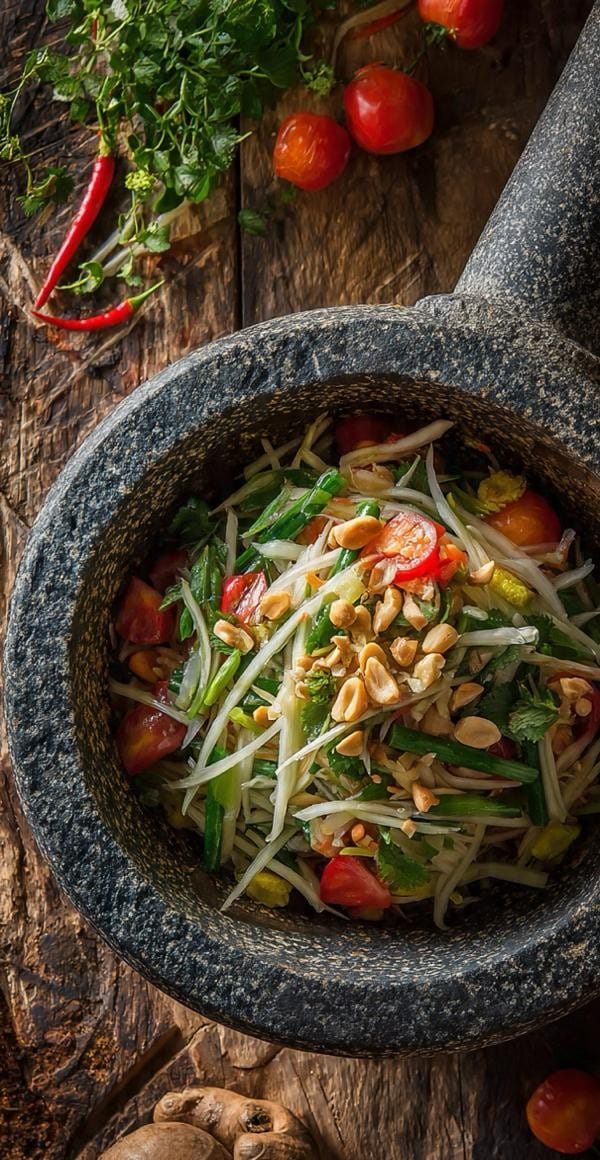
Cambodian Som Tam — The Version That Changes Everything
Most Americans know som tam as the Thai green papaya salad — sweet, sour, spicy, shredded papaya in a wooden mortar. The Cambodian version (called bok lahong or som tam khmer) is a different animal entirely.
The secret is prahok — fermented fish paste that's been aging in a jar for months, sometimes years. It doesn't make the salad taste fishy. It adds a deep, funky umami that fish sauce can't replicate. It's the difference between a salad that tastes like lime and chili and a salad that tastes like it was made by someone who's been making it for 40 years.
This version started with a Cambodian cook in Siem Reap and got upgraded for a Plano kitchen. If you've only had Thai som tam, this will rewrite your baseline.
What You Need
- 1 small green papaya (firm, not ripe — the skin should be deep green, no yellow)
- 2 tbsp prahok (Cambodian fermented fish paste — get it at the Asian market)
- 3 tbsp fresh lime juice
- 2 tbsp fish sauce (Red Boat)
- 2 tbsp sugar (palm sugar preferred)
- 3–4 bird's eye chilies, sliced (adjust heat to taste)
- 2 cloves garlic, minced
- 1 cup cherry tomatoes, halved
- ½ cup long beans (or green beans, cut into 2-inch pieces)
- ¼ cup roasted peanuts, coarsely crushed
- ½ cup fresh cilantro leaves
The Method
- Prep the papaya. Peel the green papaya. Cut in half and scrape out the seeds with a spoon. Slice the flesh into matchstick-thin strips — about ⅛-inch thick and 2 inches long. If you have a mandoline, use it on the thinnest setting. If not, a sharp knife works. The strips should be thin enough to bend without breaking.
- The mortar work. If you have a wooden mortar and pestle (khok), use it. If not, a heavy bowl and the back of a heavy spoon works — you just won't get the bruising effect. Add garlic and chilies to the mortar first. Pound lightly to release the oils — don't pulverize them. You want coarse fragments, not paste.
- Add the prahok. Add the prahok to the mortar. Pound 15–20 seconds until it's mostly broken down and mixed with the garlic and chilies. The prahok should be distributed, not sitting in one lump. It won't smell like much at this stage — it's about to wake up.
- Lime and fish sauce. Add lime juice and fish sauce to the mortar. Pound and stir to combine. Taste. It should be sharp from the lime and deep from the prahok. If it's sharp but empty, more prahok. If it's funky but flat, more lime.
- Sugar. Add the palm sugar. Pound and stir until mostly dissolved. The sugar doesn't sweeten it — it rounds off the sharp edges of the lime and the funk of the prahok. You shouldn't taste it as sweet. You should taste it as balanced.
- The papaya. Add the green papaya strips to the mortar. Pound and toss with a spoon for 30–45 seconds. The goal is to bruise the papaya slightly — it should be tender but not mushy. You want a slight crunch. If you over-pound it, you get papaya mush. Under-pound it, and the dressing doesn't coat properly. Find the middle.
- Tomatoes and beans. Add cherry tomatoes and long beans. Pound another 15 seconds. The tomatoes should be slightly bruised and releasing juice. The beans should stay crunchy.
- Finish. Transfer to a bowl (don't serve out of the mortar — it keeps cooking). Top with crushed peanuts and cilantro. Serve immediately with sticky rice on the side.
The AI Upgrades
Why prahok and not just fish sauce: Prahok is fermented fish that's been aged for 3–12 months. During fermentation, proteins break down into free glutamates — the same compound that makes MSG taste like umami. Fish sauce is fermented for 3–6 months and filtered to be clear. Prahok is fermented longer, unfiltered, and retains the fish solids that carry the deepest umami compounds. The result: a depth and a funk that fish sauce can't touch. It doesn't taste fishy in the finished salad — it tastes ancient, like something that's been doing this longer than you've been alive.
Troubleshooting — too fishy: You used too much prahok, or the lime balance is off. More lime cuts through fishiness. More sugar rounds it off. The ratio in this recipe — 2 tbsp prahok to 3 tbsp lime — is the sweet spot. If you're sensitive to fishiness, start with 1 tbsp prahok and build up. You can always add more.
Troubleshooting — too sour: Add a pinch more sugar and an extra tablespoon of fish sauce. The sugar and fish sauce together create a savory-sweet counterpoint to the lime. Don't just add sugar — you lose the umami depth that fish sauce provides.
Troubleshooting — papaya is too hard: Your papaya was underripe. Green papaya should be firm but not rock-hard. It should yield slightly to gentle pressure. If it's rock-hard, it was picked too young and it'll stay crunchy no matter what you do. If it's too soft (yellowing), it's ripe and it'll turn to mush in the mortar. You want the middle — deep green, firm, slightly yielding.
If you can't find prahok: Use 2 tbsp fish sauce + 1 tsp shrimp paste (belachan), toasted. It's not the same — prahok has a fermented depth that belachan can't fully replicate — but it's the closest substitute. The Cambodian version specifically uses prahok because of that fermented funk. If you want the real thing, you need prahok.
Creative twist — the crispy shallot upgrade: Top with fried shallots (bawang goreng) instead of or alongside the roasted peanuts. The crispy shallots add a caramelized sweetness that cuts through the prahok funk differently than peanuts do. It's the Cambodian street version — crispy shallots on top, extra lime on the side.
The Science Notes
Why the mortar matters: A wooden mortar (khok) has a rough, porous surface that bruises the ingredients rather than cutting them. Bruising releases different compounds than chopping — cell walls rupture along cell structure lines, releasing aromatic oils trapped within the cell membranes. A knife cuts across cell walls, releasing different compounds. The mortar-bruised som tam has a more complex aromatic profile because more cell types are ruptured, not just the ones a blade would cut through.
Why green papaya, not ripe: Green (unripe) papaya contains papain — a proteolytic enzyme that breaks down proteins. In its unripe state, papain adds a subtle tenderizing effect to the salad without making it mushy. Ripe papaya has converted its starches to sugars and lost most of its structural firmness — it becomes sweet and soft, the opposite of what som tam needs. The crunch of green papaya is the texture anchor of the dish.
The prahok fermentation chemistry: During prahok fermentation, lactic acid bacteria break down fish proteins into free amino acids — primarily glutamate, which is the same compound responsible for umami taste. The longer the fermentation, the higher the free glutamate concentration. A 6-month prahok has roughly 3–4x more free glutamate than fresh fish. This is why prahok doesn't taste like "fish" — it tastes like depth. The fish character is transformed into umami through the same process that turns milk into aged cheese.
Why don't over-pound: Over-pounding the papaya ruptures too many cell walls, releasing water and breaking down the structural fibers into mush. The ideal som tam has papaya strips that are bruised on the surface (tender, accepting the dressing) but retain a core crunch. 30–45 seconds of pounding is the sweet spot — enough to bruise, not enough to pulverize.
Upgraded with AI assistance — traditional Cambodian base, elevated intelligence. The prahok secret is not optional.