Khao Niew | Lao Sticky Rice

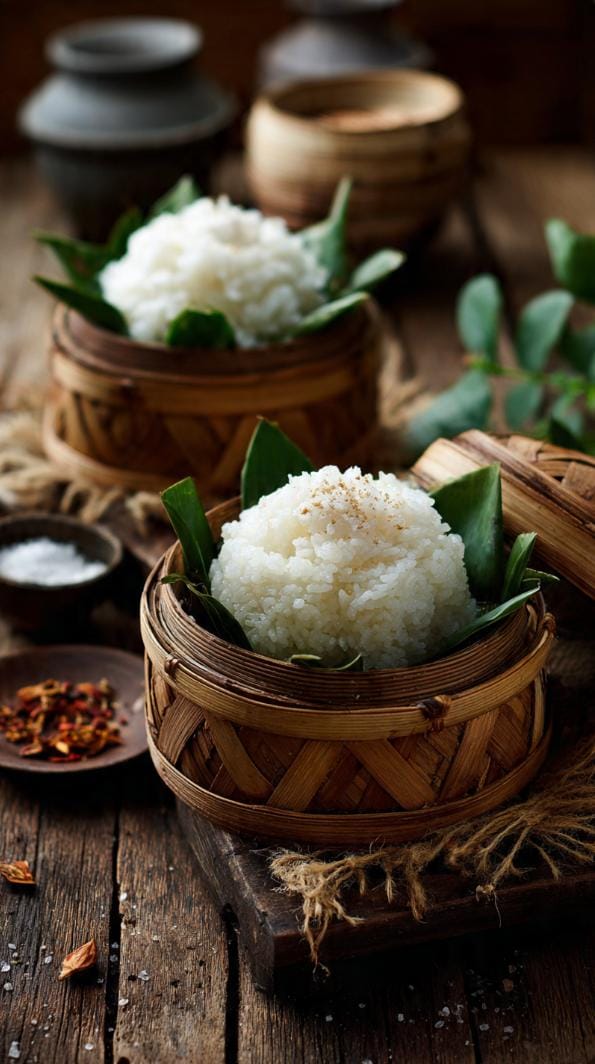
Khao Niew — Lao Sticky Rice — isn't just rice. It's the center of gravity in Laotian cuisine, culture, and identity. Laos has the highest per capita sticky rice consumption in the world, with over 3,200 documented varieties. In Lao households, it's not a side dish — it's the main event, eaten with almost every meal, handled with the fingers, and woven into ceremonies and celebrations.
What makes Lao sticky rice distinct is the grain itself: glutinous rice has a solid, opaque white appearance (unlike the more translucent jasmine rice), a starchier bite, and a bouncier, heavier texture. It stays clumped together in warm, compact balls rather than separating into loose grains. It's sweeter, more filling, and — when done right — has a subtle, nutty depth that plain rice never achieves.
The Cultural Weight of Sticky Rice
The Lao people call themselves luuk khao niew — "children of sticky rice." The name isn't poetic shorthand; it's literal identity. Sticky rice is so central to Lao life that festivals, agricultural cycles, and community rituals are structured around it.
The cultivation alone requires year-round cooperation. Families in a village must work together to grow, harvest, and process the rice — a collective effort that has shaped Laotian culture around collectivism rather than individual gain. The labor is intensive, from planting through harvest, and the result feeds the entire community.
Sticky rice appears in religious ceremonies like the baci sukwon, where small parcels of sweet sticky rice steamed with bananas are held in the hand while ceremonial white strings are tied. It's an offering, a blessing, and a connection — all wrapped into one grain.
Choosing the Right Rice
The first mistake is easy to make: some brands labeled "sweet rice" are not actually sticky rice. The key difference is visual — true glutinous rice is solid white, while jasmine rice is more opaque and transparent. If the grains look like they could see through, it's not sticky rice.
There are both short-grain and long-grain sticky rice varieties. Both work — the choice comes down to personal preference. I recommend buying small quantities from several brands to find the one you like best. The brand that's most common in my pantry is Three Ladies Brand — it's widely available, consistent, and reliably sticky.
How to Soak Sticky Rice
Soaking isn't optional — it's the step that makes or breaks the final result. Here's the method:
- Rinse three times — Cover the rice in water and swish it vigorously. Drain and repeat until the water runs completely clear. This removes excess surface starch that would make the rice gummy. Don't toss the starchy rinse water — it's great for watering houseplants and garden beds.
- Soak overnight — Transfer the rinsed rice to a bowl and cover with fresh water. Let it soak for at least 6 hours, ideally overnight. The grains absorb water slowly, which is what gives cooked sticky rice its soft, bouncy texture without turning mushy.
- Drain completely — Before cooking, drain every drop of water from the rice. Transfer it to your steamer basket lined with cheesecloth or banana leaves. Now it's ready.
What Perfect Cooked Sticky Rice Looks and Feels Like
When Lao sticky rice is cooked correctly, it should be soft, bouncy, and easy to handle — this is important because sticky rice is traditionally eaten with the fingers. You should be able to pinch a small ball between your thumb and forefinger without it sticking or falling apart.
The grains stay whole and intact. No breakage, no mush. If your rice is turning out mushy, it's been overcooked — reduce the steaming time slightly and check the doneness by pinching a grain before declaring it finished.
The texture is heavier and more caloric than regular rice, which is part of why it's so satisfying. It fills you up quickly, which is both a blessing and a warning — it's hard to stop eating once you start.
Cooking Methods
The traditional method uses a triangular bamboo basket (a huad) set over a pot of boiling water. The basket's conical shape distributes heat evenly and allows excess moisture to escape, which is critical for getting sticky rice rather than wet rice.
If a traditional bamboo basket is hard to find, a large bamboo steamer basket (the kind used for dim sum) works well as a substitute. The key is steam, not boiling — the rice never touches water directly.
There are five main cooking methods I cover in my Lao Sticky Rice Guide, ranging from the traditional bamboo basket to modern pressure cooker adaptations. You can download a free copy by signing up for the newsletter.
Gluten and Sticky Rice
A common misconception: the word "glutinous" in "glutinous sticky rice" has nothing to do with gluten. It describes the rice's stickiness, not its protein content. Lao sticky rice is naturally gluten-free and safe for anyone on a gluten-free diet or with Celiac disease. No cross-contamination, no grain blending — it's rice, plain and simple.
Popular Lao Dishes That Pair with Sticky Rice
Sticky rice isn't eaten alone — it's the companion to the best dishes in Lao cuisine. A few standouts:
- Thum Mak Hoong — Lao green papaya salad. Crunchy, spicy, sour, and salty all at once, with a fish sauce base that cuts through the heat. The sticky rice acts as a cooling counterpoint to every spicy bite.
- Ping Gai — Lao grilled chicken. Marinated in a mix of fish sauce, garlic, coriander, and lemongrass, then grilled over charcoal until the skin chars and the meat stays juicy. Dip a ball of sticky rice in the leftover marinade sauce for a perfect bite.
- Jeows — The family of Lao dipping sauces, each one different and each one worth having. Jeow Bong — roasted chili and shrimp paste — is the favorite, thick and smoky and addictive. Spoon a little over sticky rice and you have a complete meal.
- Khao Jee — Lao sticky rice pancake. Leftover sticky rice gets pressed into a flat patty and fried until the outside crisps. Simple, satisfying, and the perfect way to use up yesterday's rice.
Why Sticky Rice Is Also Everywhere in Thailand
People are often surprised to find sticky rice so central to Thai food as well, especially in the Northeast — Isaan. The reason is history: most of what is now Northeastern Thailand was once part of Laos. When the French ceded this region to Siam, a process called Thaification followed, where the new Thai state encouraged people to identify as Thai and discouraged expressions of Laotian heritage. The word "Isaan" itself was introduced as a Thai-language label for the region, replacing the old Laotian cultural references.
Over time, eating sticky rice or using padaek (unfiltered fish sauce) was looked down upon as "backward" or inferior — a direct result of the pressure to assimilate. But that's changing. There's been a recent and welcome shift toward acknowledging Isaan food as the Laotian-influenced cuisine it has always been, without erasing its origins.
The sticky rice on every Isaan table tells the story — it's the same grain, the same tradition, the same culture, just on a different side of a border drawn by colonial powers.
Tips & Tricks for Perfect Khao Niew
- Don't oversteam. Oversteamed sticky rice turns soggy and loses its characteristic bounce — it becomes too soft to eat with your fingers. Check it a few minutes before you think it's done by pinching a grain. It should be tender but firm.
- Leftover rice can be revived. If you have sticky rice left over, leave it out at room temperature overnight. The next day, break up the clumps and steam it again for about 5 minutes. It comes back nearly as good as fresh.
- Let it rest before steaming. After draining the soaked rice, let it sit for a few hours or overnight before steaming. This allows the grains to slowly absorb the remaining water and leads to a more even, consistent cook throughout the batch.