The Wireframe Sublime: Even Our Visions Get Flattened

The Wireframe Sublime: Even Our Visions Get Flattened
*"We built screens to see everything. Instead, they teach us to see nothing fully."*
---
The Figure
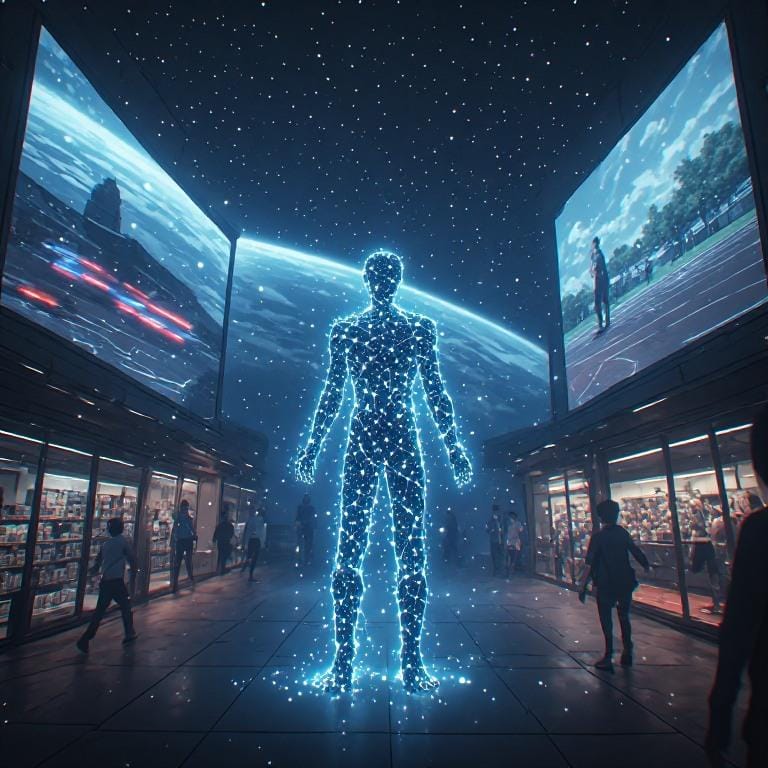
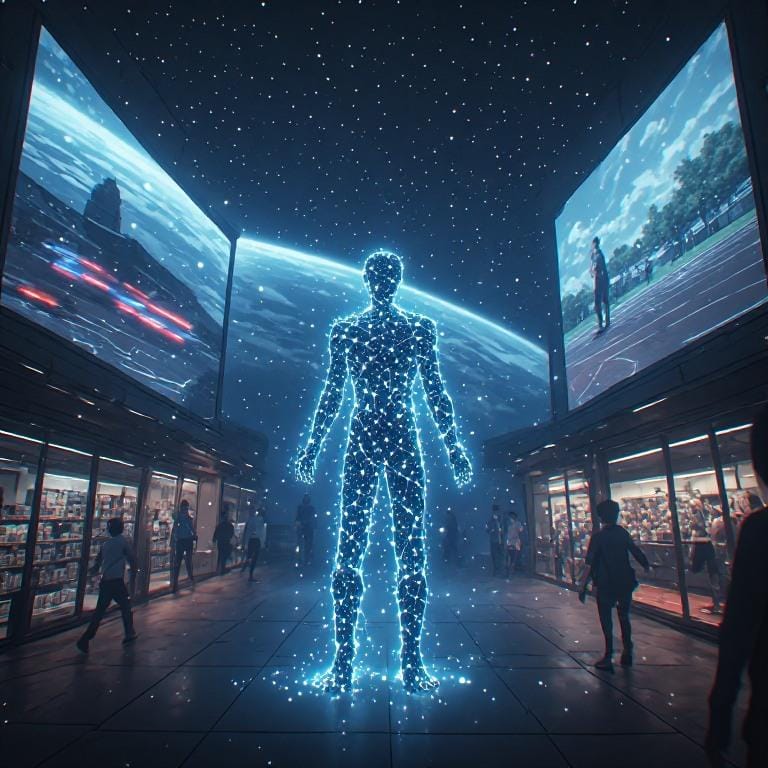
A luminous human figure stands in a vast, dark space.
Bright blue and white light outlining something that looks human — but is no longer human. A network of light. A digital wireframe. Not flesh, not history, not the weight of a life. Just the outline. Glowing. Precise. Safe to look at.
Large video screens frame the scene, each one projecting expansive, ethereal landscapes. Mountains. Oceans. Sky that goes on forever. The kind of vistas that should stop your breath. That should make you feel small, and vast, and part of something larger.
Instead, they are content. Each one displayed, framed, contained. Available for viewing.
This is what the figure is watching. And this is what we are all watching.
---
The Sublime, Flattened
The ancients had a word for what those screens are trying to show: the sublime.
Not pretty. Not nice. *Sublime* — the experience of standing before something so vast, so powerful, so beyond your comprehension that it rearranges you. A mountain range at dawn. The ocean at night. The recognition that you are small and the world is enormous and that both are true at once.
The sublime does not reduce you. It expands you — if you let it.
But the screen does not let it.
The screen takes the sublime and puts a frame around it. It takes the ocean and makes it wallpaper. It takes the mountain and makes it a background. It takes the rearrangement of your soul and turns it into something you can scroll past in three seconds.
The wireframe figure does not experience the sublime. It experiences the *simulation* of the sublime — luminous, controlled, available on demand. No rearrangement required. No weight. No cost.
This is the deeper flattening: not only are people reduced to outlines. The very experience of being overwhelmed, of being small before something greater, has been packaged and put behind glass.
---
What We Lose When Nothing Overwhelms Us
The sublime is uncomfortable. It resists wireframing. You cannot headline a mountain range. You cannot tweet a sunset that has rearranged your interior life in a way you cannot explain. The sublime insists on being more than what you can say about it.
So the screen offers a solution: render it luminous. Make it glow. Put it on a screen next to a wireframe figure so it looks like the figure is having the experience — without the mess of actually having it.
This is not a metaphor for alienation. It is a description of it.
We have built an entire civilization around the principle that nothing should overwhelm anyone. If a view is too vast, frame it. If a feeling is too large, post it. If a moment is too heavy, scroll past it. The wireframe is the unit of everything now — people, visions, experiences, emotions. Reduce it to the outline. Make it glow. Put it on the screen.
The problem is not the screens. The problem is that we stopped looking at anything else.
---
The Monk Again (Without the Robes)
Put the robes aside. What remains is a stance: *do not consume what you cannot receive.*
The wireframe figure consumes everything — landscapes, crowds, moments, people — because it cannot receive anything. Receiving requires something to give to. Receiving requires that you be altered by what you encounter. The wireframe cannot be altered. It is already outlined. It is already complete.
The monk's practice is the opposite of consumption. It is the willingness to be changed by what is before you. Not to frame it. Not to capture it. Not to share it. Just to let it touch you and leave something different afterward.
This is not spirituality. This is a basic competence: the ability to encounter something without immediately reducing it to what you can say about it.
Most of us have lost it. We have been trained to reduce. The screens reward reduction. The feeds optimize for reduction. The algorithms wireframe everything and feed us the outlines because outlines travel fast. Depth does not.
---
The Machine That Learned to Flatten
AI and automation extend this logic to its natural conclusion. A machine does not have a self to be overwhelmed. It does not have a soul to be rearranged. It only has inputs and outputs — and the output is always a wireframe. Always a reduction. Always something that can be processed, categorized, acted upon.
When we hand judgment to a system that cannot be overwhelmed, we are building a world in which nothing is ever overwhelming. In which no one ever has to stop. In which no one ever has to change their mind because the weight of something they encountered was too heavy to carry back to their previous position.
The sublime requires that you change. The wireframe requires nothing. It is the perfect companion to a civilization that has forgotten how to be altered by anything.
---
How to Be Overwhelmed Again
You cannot do this on a screen. The screen will always flatten. This is not a failure of willpower. It is the nature of the medium. Screens do not show you things. They show you renderings of things.
To see the sublime — to let it actually touch you — you have to step away from the rendering.
Go outside. Stand somewhere tall. Let the scale of it land before you try to capture it. Do not take the photo first. Let the moment happen. Let it rearrange you. If it is too big for words, do not force the words. Some things are not for posting.
Look at a person — not their profile, not their feed, not their wireframe — and wait. Let the complexity land. Let the contradictions hold. Do not resolve them into something shareable. Let them stay unresolved. That is where the person actually lives.
This is not nostalgia for a world before screens. This is a diagnosis of a world that has mistaken the wireframe for the person, the rendering for the landscape, the outline for the life.
The luminous figure stands in the dark, glowing, framed, complete. The screens glow back. Everything is visible. Nothing is seen.
Step out of the frame. Stand in the dark without the outline. Let something vast and unrenderable touch you.
That is the only thing that has ever been real.
---