The Wireframe Effect: How We Lose Each Other

The Wireframe Effect: How We Lose Each Other
*"When you look at a person and see only a wireframe — a shape, a category, a headline — you are not seeing them. You are seeing a reduction of them. And from that reduction, all harm follows."*
---
The Arena
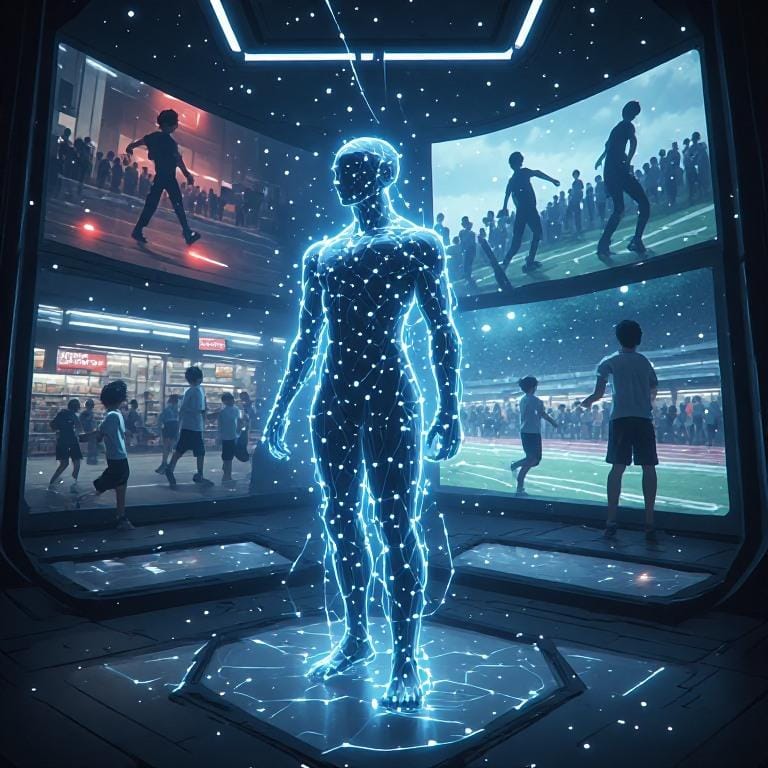
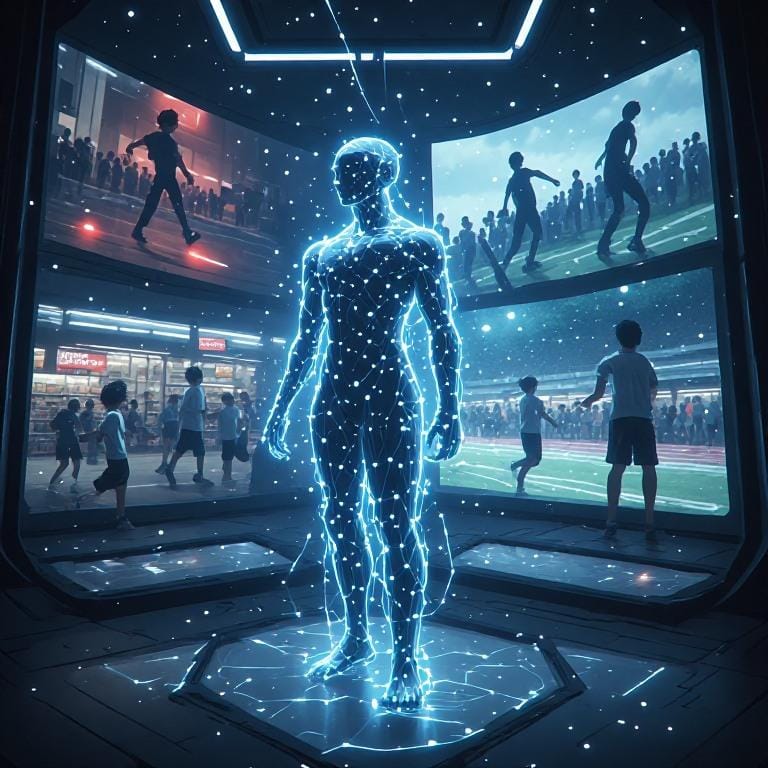
A luminous wireframe figure stands at the center of a futuristic arena.
Glowing blue outline. Geometric base. Surrounded by large screens — athletes, crowds, noise, spectacle.
This is not a rendering of the future. It is a rendering of the present.
Every screen is a filter. Every headline is a wireframe. Every viral clip is someone reduced to a single frame, a single action, a single frame of context — stripped of everything that makes them a human being.
The tragedy of Karmelo Anthony and Cyrus is not only what happened that night. It is how quickly everyone around it collapsed into wireframes.
---
The Wireframe Effect
Two Black witnesses testified against Karmelo Anthony. That became a wireframe: *witnesses*, *testifying*, *against*. Their words became weapons — simplified, weaponized, stripped of the circumstances of why they testified, what they saw, what they carried into that room.
Cyrus had a gun. Posted it on social media. That became a wireframe: *armed*, *online*, *threatening*. His drop of the gun while running — a moment of fear, of survival, of panic — disappeared into the wireframe. The action alone was enough. The context was not needed.
Wireframes are comfortable. They take a messy, contradictory, deeply human situation and flatten it until it fits a narrative. You don't have to think. You don't have to wonder. You just have to react.
But people do not live as wireframes. They live as texture, contradiction, history, fear, hope, mistake, intent. The wireframe is a lie by omission — not because it's false, but because it is incomplete by design.
---
The Ancient Frame
Take the Buddhist monk. Put the robes aside. What remains is a particular stance toward the world:
*Do not reduce. See fully. What you reduce, you can destroy without remorse.*
This is not religion. This is observation. The mind that wireframes a person is the same mind that can walk past someone bleeding on the sidewalk. Not because it is cruel — but because it has already decided what that person is. The reduction happened first. The violence followed.
The monk's practice is the opposite: see the person as they are — not as you have been told they are, not as the screen shows them, not as the headline wants them to be. See the full texture.
This is harder than it sounds. It requires holding contradiction: a person can be both threatening and afraid. A witness can be both truthful and partial. A community can grieve for both sides. Most of us cannot hold that. So we collapse.
---
Racism Is a Wireframe Factory
Racism is the industrial-scale production of wireframes. It takes a human being — full, complex, contradictory — and outputs a simplified, predictable, dangerous shape. The shape justifies fear. The fear justifies action. The action justifies the original reduction. It is a closed loop of manufactured simplicity.
The same mechanism runs at every scale:
- The shooter who wireframes a stranger and pulls the trigger.
- The witness who wireframes a defendant and testifies without nuance.
- The poster who wireframes a victim and celebrates their end.
- The algorithm that wireframes a community and sends more police.
- The viewer who wireframes a tragedy and shares it as spectacle.
Each act of reduction is small. Together, they are the machine.
---
AI, Robots, and the New Wireframes
We are now building machines that wireframe at scale and call it intelligence.
An AI that "recognizes" a person from a face has not seen them. It has matched pixels against a database. It has produced a wireframe and labeled it with a confidence score.
A robot that patrols a neighborhood has not encountered a community. It has processed inputs against thresholds. It has produced wireframes and acted on them.
When we hand decision-making to systems that cannot see full humanity — because they cannot see humanity at all — we are outsourcing the wireframe effect to machines that will never hesitate. The risk is not that AI will become evil. The risk is that it will become *efficient* at what humans are already bad at: reducing people to data points and acting without mercy.
This is the new front of the same war. Different weapons. Same mechanism.
---
How to See Again
If the problem is reduction, the work is expansion.
When you hear a name in a headline — stop. Ask what is missing. The context, the backstory, the version of events from a different seat. Not to take a side. To refuse the wireframe.
When you feel the urge to share — stop. Ask what you are reducing to make it fit a post. The person, the moment, the weight of it. If you cannot carry the full weight, do not share the reduction.
When you encounter someone different from you — stop. Ask what wireframe you are already wearing. The one you inherited. The one the screens gave you. The one that says you already know who they are.
This is the work. Not grand gestures. Not moral superiority. Just the refusal to collapse a human being into anything less than what they are.
The wireframe figure in the arena glows. It looks precise. Clean. Safe.
Reality is not. Reality has texture, and weight, and contradiction, and edges that do not fit into any base. The work of being human — the actual work, not the performance — is staying in the mess long enough to see it.
---
The Arena Is Everywhere
Every screen is an arena. Every feed is a crowd. Every headline is a screen showing athletes and crowds — except now it is people, and the athletes are all of us, performing for an audience that has already decided what we are.
The wireframe figure stands at the center, glowing, and the screens reflect its light back at it. It looks like progress. It looks like clarity. It looks like seeing.
It is not seeing.
It is the exact opposite: the elimination of seeing.
To look at a person and see the wireframe is not to understand them. It is to have already stopped trying. And from that stopping point — that small, quiet surrender to the reduction — everything else follows.
The question is not what the wireframe shows. The question is what you are willing to do when you realize it is not enough.
---
*The luminous figure stands. The screens glow. But you — you can choose to step out of the arena, walk past the screens, and see the person standing there. No wireframe. No base. No light show.*
*Just them.*
*That is the only seeing worth having.*
---