The Mirror of Faces

The Mirror of Faces
*"We built a thousand mirrors and forgot what our own face looks like."*
---
The Screen That Shows Only Itself
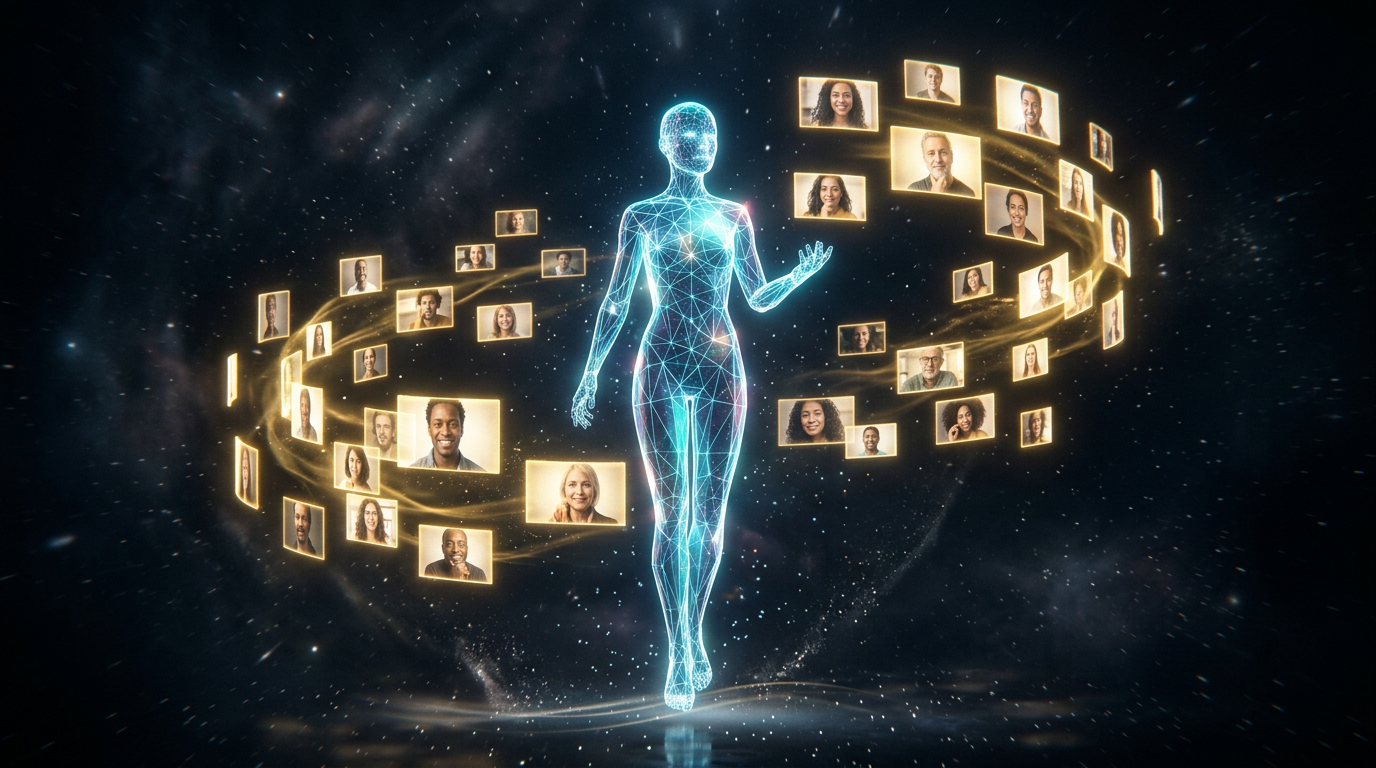
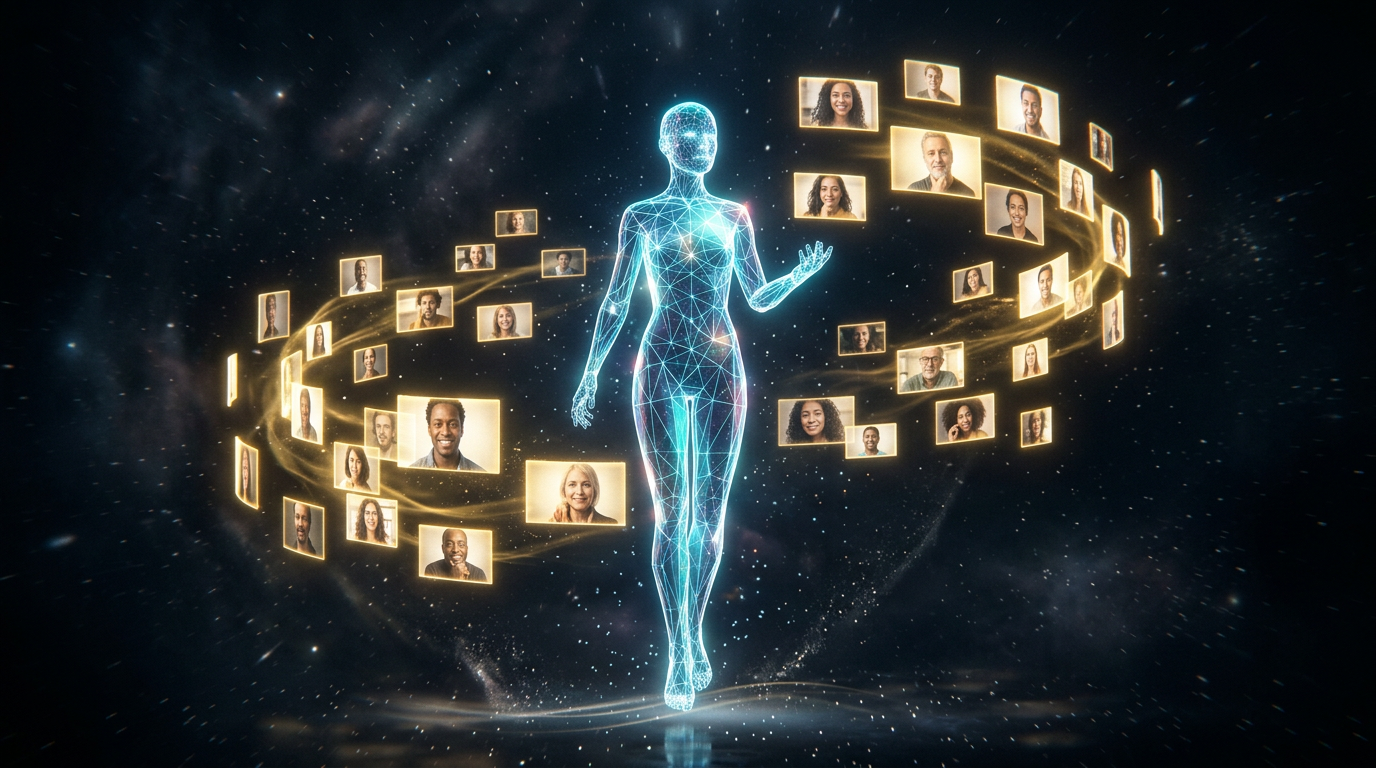
A luminous wireframe figure stands in a dark void.
Surrounding it are screens. Each screen shows a face looking back.
The faces are warm. The figure is cold light.
The figure looks at the screens. The faces in the screens look at the figure. No one is looking at each other.
This is not a science fiction scene. This is what your feed looks like. This is what a protest looks like through a phone camera. This is what a court transcript looks like when the witness has been reduced to a headline. This is what a Black life looks like when the only record is a 10-second clip and a dozen takes afterward.
The figure in the center — glowing, outlined, wireframed — has been reduced to a shape. The faces on the screens have been reduced to images. And the screens themselves are the only thing any of them can see.
---
The Reduction Is the Point
To reduce someone to a face on a screen is not to see them. It is to make them visible *to others* while making them invisible to themselves.
The faces on the screens are performing. They know they are being watched. They adjust. They frame themselves. They hold poses. The person behind the face goes quiet — because the face is what travels, what gets shared, what becomes evidence or entertainment or a viral moment.
The wireframe figure in the center is the same thing, only further reduced. No face at all. Just the outline. The minimum necessary to say: *this was here*. Shape without texture. Form without history. Light without warmth.
Both the figure and the faces have been processed by the same machine. The machine takes something full and produces something that travels.
---
The Witness Who Does Not See
Two Black witnesses testified against Karmelo Anthony.
Their faces were not on the screens. Their words were. Their testimony was captured, parsed, weaponized, shared. No one asked what it cost them to speak. No one asked whether they saw the whole thing or only what was in front of them. No one asked what the room felt like when they stood up.
The reduction happened before they finished their first sentence. Witness. Testifying. Against. The wireframe appeared instantly. From there, everything else was just color.
This is the mechanism in its simplest form. Someone speaks. You hear the category. The rest disappears.
The witness testifies. The court records the words. The public reduces the words to a position. The feeds turn the position into a take. The take becomes the person. The person is gone.
---
The Face You Never See
Look at someone's profile picture. Really look at it.
What do you see? A face. A smile, maybe. Good lighting. The version they chose to show you. But what you are not seeing is the version that exists when no camera is running. The face that has cried. The face that is tired at 2 a.m. The face that looks nothing like the avatar.
The avatar is a wireframe. It travels. It represents. It replaces.
The real face stays behind. Unwatched. Unshared. Unreduced. It is the only one that matters — and it is the only one you will never encounter on a screen.
---
The Monk's Gaze (Again)
Put the robes aside.
What remains is the refusal to take the reduction.
When you look at a face on a screen — do not settle for what it shows. Ask what is behind it. Not out of suspicion. Out of respect. The respect owed to any human being who exists more fully than you can see.
This is not paranoia. It is the opposite. It is the willingness to assume that what you are seeing is less than the person standing there.
The monk's practice is exactly this: to encounter a person and refuse to collapse them. To hold the face and the wireframe both, knowing the face is more — and being content with never fully possessing the more.
---
AI and the Final Mirror
Artificial intelligence is the final form of this mirror.
An AI "sees" a face and returns a classification. Confidence score. Embedding. Wireframe labeled with probability. It has not encountered a person. It has matched pixels against a dataset.
When we use AI to identify, to judge, to score, to sort — we are building a world in which every person is first reduced to data, then acted upon at the speed of computation. No hesitation. No second look. No recognition of the irreducible remainder that every human being is.
The AI cannot see what it does not measure. And what it does not measure does not exist in its world.
We are giving the wireframe the power to act on the faces. And the faces have no idea they are being reduced until the reduction has already decided their fate.
---
How to Break the Mirror
You cannot fix this by being nicer to screens. The screen is not the problem. The reduction is.
When you see someone reduced — a headline, a clip, a take, a classification — pause. Name the reduction out loud. *This is a wireframe. This is a face on a screen. This is not the person.*
Do not share the reduction. Do not build on it. Do not let it become the foundation of anything you believe or say or act on.
When you look at your own face on a screen — the one you curated, the one you perform — remember: that is not you. That is the avatar. You are the one behind it. The one who does not travel. The one who is never fully seen.
That version of you is the only one worth protecting.
---
*The luminous figure stands. The faces glow back on their screens. But you — you can step out of the arena, walk past the screens, and look at a person. Not the avatar. Not the wireframe. Not the headline.*
*The face that does not travel.*
*That is the only meeting worth having.*
---