The Mesh Remembers

The Mesh Remembers
*"The wireframe is not a cage. It is a web. And webs hold things that cages cannot."*
---
The Figure Is Not Alone
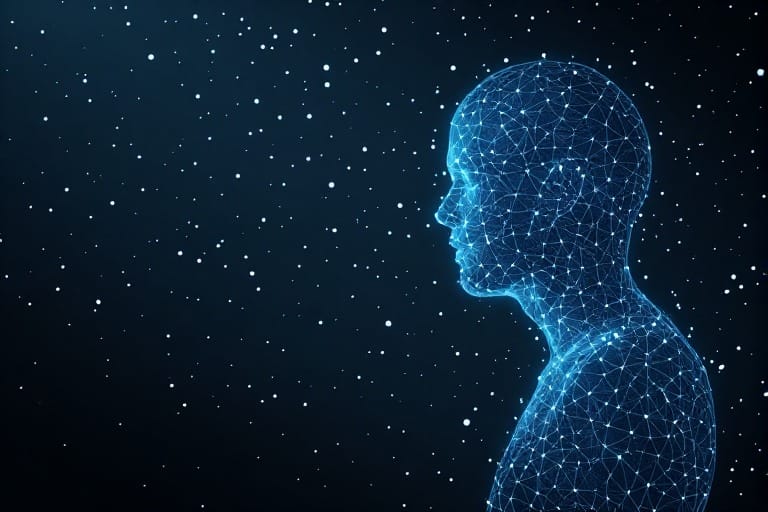
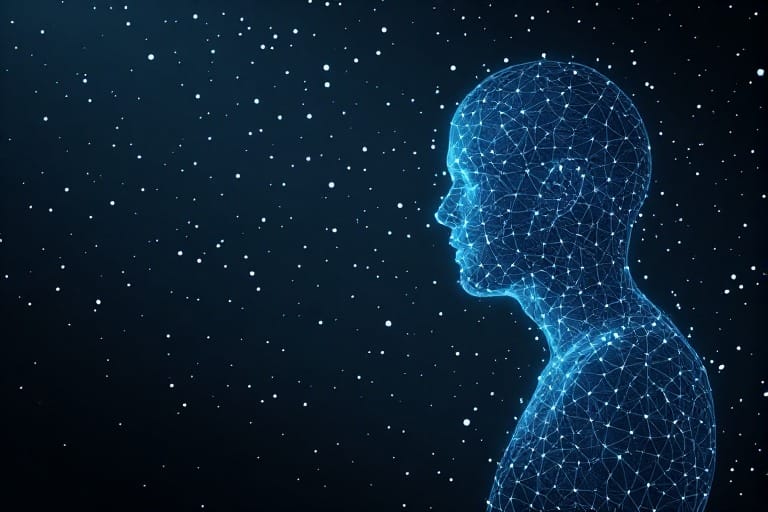
Look closely at the luminous figure in the dark.
It is not just an outline. It is a mesh — thousands of glowing points, connected by filaments of blue and cyan light, woven into something that resembles a human shape but is made of *relation*.
Every point is connected to every other point. The shoulder reaches the arm. The arm reaches the hand. The hand reaches the space around it.
The figure is not a body trapped in a wireframe.
It is a body *made of connection*.
---
What the Mesh Knows That the Wireframe Does Not
A wireframe reduces. It says: this is the shape, nothing more. The rest is noise.
A mesh remembers. Every node in this figure is a point that once touched something else — a hand that held, a shoulder that bore weight, a chest that held breath, a head that turned toward sound.
The reduction forgets these things. The mesh does not.
The mesh is a map of every contact the figure ever made. The hand that reached for a doorknob. The shoulder that a child cried on. The chest that held another chest in the dark. The head that turned toward a voice in a crowd.
None of this is visible in the silhouette. All of it is encoded in the mesh.
---
The Network as Witness
Consider what the mesh would say if it could speak.
It would not say: *I am a shape.*
It would say: *I am all the hands that ever held me.*
The luminous points are not decoration. They are evidence. Evidence that this figure was not built — it was *lived*. Every connection in the mesh is a moment of contact, preserved in light.
This is what the wireframe mode of seeing cannot grasp. It looks at the outline and sees only geometry. It does not see the web of relations that produced the shape.
The mesh sees differently. It knows that no human being is a standalone geometry. Every person is a node in a network so vast it would make the stars look sparse — hands, voices, touches, silences, mornings, nights, the weight of every person who ever mattered to them, pulsing through the mesh like current through wire.
---
The Violence of the Single Node
When you reduce a person to a wireframe — a shape, a category, a headline, a data point — you are treating them as a single node. Isolated. Alone. Contained within their outline.
But people are not single nodes. They are the entire network that reaches outward from them. The person you wireframed is carrying the weight of every connection in their mesh — every person who ever loved them, every person who ever hurt them, every person whose life intersected theirs in a way you will never know.
To reduce them is to cut the mesh. To pretend the connections are not there.
This is what makes the reduction violent — not the act of seeing, but the act of *severing*. Of treating a network as a point. Of treating a web as a cage.
---
The Monk and the Web
Put the robes aside. What remains is a different kind of attention:
*Do not look at the outline. Look at the connections reaching beyond it.*
This is harder than it sounds. The outline is visible. The connections are not — not in any way the eye can track. You have to infer them. You have to assume them. You have to accept that what you cannot see is more real than what you can.
The monk's practice is exactly this: to encounter a person and recognize that the visible part is the smallest part. That the mesh extends beyond what any frame can hold. That the person standing before you is not a point but a web — and the web reaches into a past you will never fully know and a future you will never fully see.
This is not mysticism. It is geometry applied to human life. The math is simple: no one is just where they appear to be.
---
AI and the Invisible Web
Artificial intelligence processes nodes. It does not process networks.
An AI that "analyzes" a person produces data points: age, income, location, purchase history, social graph. These are single-node measurements. The AI never sees the mesh. It never encounters the connections. It never feels the weight of the network pulsing through the person it is scoring.
When we hand judgment to systems that cannot perceive networks, we are building a world in which every person is treated as a single point — measurable, predictable, containable. The mesh is invisible to the algorithm. And what the algorithm cannot see, it cannot protect.
This is the danger. Not that AI will become evil. But that it will become *efficient at treating networks as points* — at cutting the web and calling it analysis.
---
The Figure in the Void Still Burns
The luminous figure stands in the dark, surrounded by points of light that suggest other figures, other nodes, other connections stretching off into the void.
It is not isolated. It is embedded. The mesh reaches into the darkness and finds other meshes, other networks, other webs of light woven from lives that intersected this one.
The reduction cannot see any of this. The wireframe cannot hold any of this.
But the mesh remembers. Every point is a contact. Every filament is a moment. Every glowing junction is a person who mattered.
The figure in the dark is not alone. It never was.
---
*Look at the mesh, not the outline. The outline is what they showed you. The mesh is what is actually there — woven from every hand that ever reached for this figure, every voice that ever called to it, every moment of contact that shaped it into what it became.*
*The mesh is the only part that is real.*
*And it is still burning.*
---