Filipino Lechon Kawali — The Upgraded Version

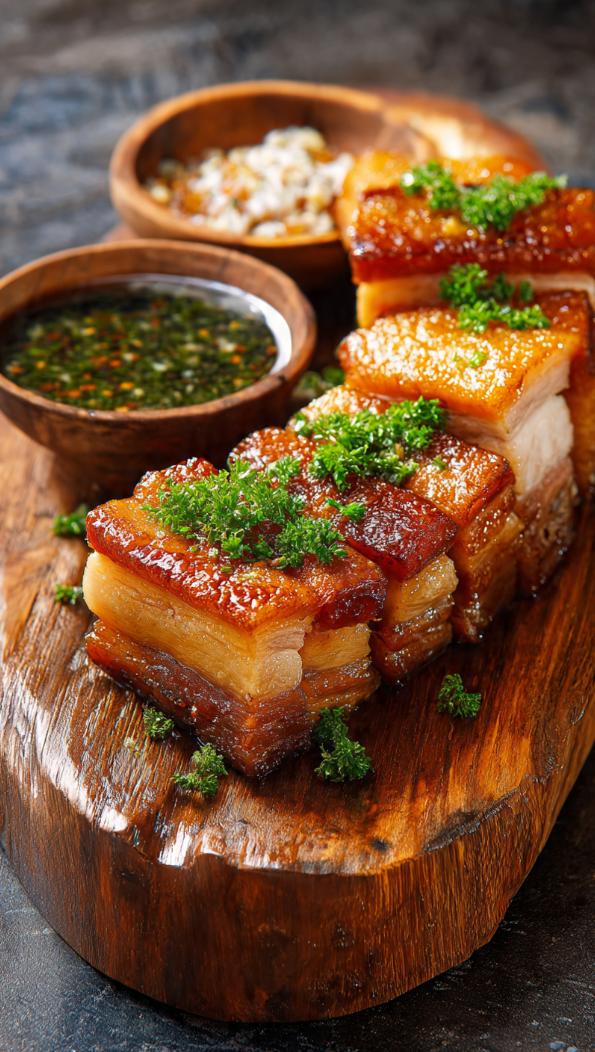
Filipino Lechon Kawali — The Upgraded Version
Lechon kawali is crispy pork belly. That's the whole point. If the skin isn't crackling when you tap it with a spoon, you've failed somewhere in the process. This version keeps the traditional technique and adds the science behind every step — so you understand why it works, not just that it works.
What You Need
- 3 lbs pork belly slab, skin-on (ask the butcher for "pork belly with rind" — the skin must be intact)
- 1 head garlic, cloves peeled and smashed
- 4 bay leaves
- 1 tbsp whole black peppercorns
- 2 tbsp salt
- Neutral oil for deep-frying (peanut oil preferred, canola works)
The Method
- Score the skin. Skin-side up on a cutting board. Use a very sharp knife (or a Stanley blade) to score in a tight crosshatch pattern — cuts about ¼-inch deep, spaced ¼-inch apart. Don't cut into the meat layer — just the skin and the fat immediately beneath it. If you cut into the meat, the juices will run out during frying and the skin won't puff.
- Marinate. Rub pork all over with garlic, bay leaves, peppercorns, and salt. Wrap tightly in plastic. Refrigerate 6–8 hours minimum. Overnight is ideal. The salt penetrates the meat layer and starts breaking down proteins — this is a dry brine, and it makes the difference between bland pork and pork that tastes like something.
- Simmer. Place pork skin-side up in a pot. Cover with water by 2 inches. Bring to a boil, then reduce to a gentle simmer. Cover and cook 45–60 minutes until the meat is tender when poked with a fork. The skin should still be intact and flexible, not starting to separate.
- Dry it — this step gets its own section because it's that important. Remove pork from pot. Pat the skin aggressively with paper towels — use as many as it takes. Then refrigerate uncovered for 1–2 hours. The skin must be completely, thoroughly dry before it touches oil. Any moisture left on the skin will turn to steam in the oil, and the skin will never puff. If you're short on time, pat it down and use a hair dryer on low heat for 5 minutes. It works.
- Score check. The skin should feel dry and slightly tacky to the touch. If it feels even slightly moist, more drying time. This is non-negotiable — if the skin is moist, the lechon will be chewy instead of crackling.
- Deep fry. Heat oil to 375°F. Lower the pork belly skin-side down first — it should sizzle aggressively the moment it touches the oil. Don't crowd the pan. Fry 8–10 minutes on the skin side until deeply golden and the skin has puffed into blisters. Flip and fry the meat side 3–4 minutes to render the fat. Internal temperature should hit 145°F.
- Rest. Let rest 5 minutes before slicing. The juices redistribute.
The AI Upgrades
Troubleshooting — skin won't puff (chewy instead of crackling): The skin was too moist going into the oil. This is the #1 cause of failure. Moisture turns to steam, which separates the skin from the fat layer and prevents the puffing mechanism. Fix: dry longer. Use a hair dryer. Use a fan. Leave it uncovered in the fridge overnight. If the skin is truly, completely dry, it will puff. There is no exception.
Troubleshooting — skin puffed but burned: The oil was too hot or the skin was too close to the bottom of the pan. 375°F is the sweet spot. If the skin starts darkening too fast, lift the pork slightly with tongs to create a gap between the skin and the pan bottom — the hot oil circulates around the skin evenly and prevents hot spots from burning.
Troubleshooting — meat is tough: You under-simmered. 45 minutes is minimum, 60 is better. The collagen in the connective tissue needs time to break down into gelatin. If you rush the simmer, the collagen stays tough and the meat is chewy even when fully cooked. Temperature matters too — a rolling boil toughens the surface proteins. A gentle simmer is essential.
Creative twist — the spice-rubbed finish: After frying and before slicing, sprinkle the skin with flaky sea salt and a mixture of toasted cumin and coriander. The spice rub adheres to the still-warm crackling. It adds a layer of complexity that makes people ask what the secret is. The secret is just salt and toasted spices applied at the right temperature.
What to do with the rendered fat: Don't throw it away. Strain it through cheesecloth and save it. Pork fat (lard) is the best cooking fat on earth. Use it to fry eggs, roast potatoes, or as the base for the next batch of lechon. It keeps in the fridge for 2 weeks and freezes indefinitely.
The Science Notes
Why the crosshatch scoring: The cuts go through the skin and into the fat layer. During frying, the fat renders (melts) and pushes up through the scored cuts, inflating the skin into blisters. If the cuts are too shallow, the fat can't push through and the skin stays flat. If the cuts go into the meat layer, the meat juices run into the fat and prevent clean puffing. ¼-inch deep is the sweet spot — through the skin, just barely into the fat.
Why drying matters: Water boils at 212°F. Oil at 375°F is 163°F hotter. If water is present on the skin surface, it flashes to steam at 212°F — 163°F below the oil temperature. The steam pushes the skin away from the fat layer instead of letting the fat push up through the skin. Dry skin = direct contact between hot oil and skin/fat interface = puffing.
Why low simmer: A rolling boil (212°F) causes the muscle proteins to seize up and squeeze out moisture, resulting in tough, dry meat. A gentle simmer (180–190°F) keeps the proteins relaxed while the collagen slowly dissolves into gelatin. The result is meat that's tender because the connective tissue has broken down, not because it's been boiled into submission.
Upgraded with AI assistance — traditional base, elevated intelligence. Always taste as you go.