Drunken Noodles (Pad Kee Mao) — The Version Nobody Else Writes

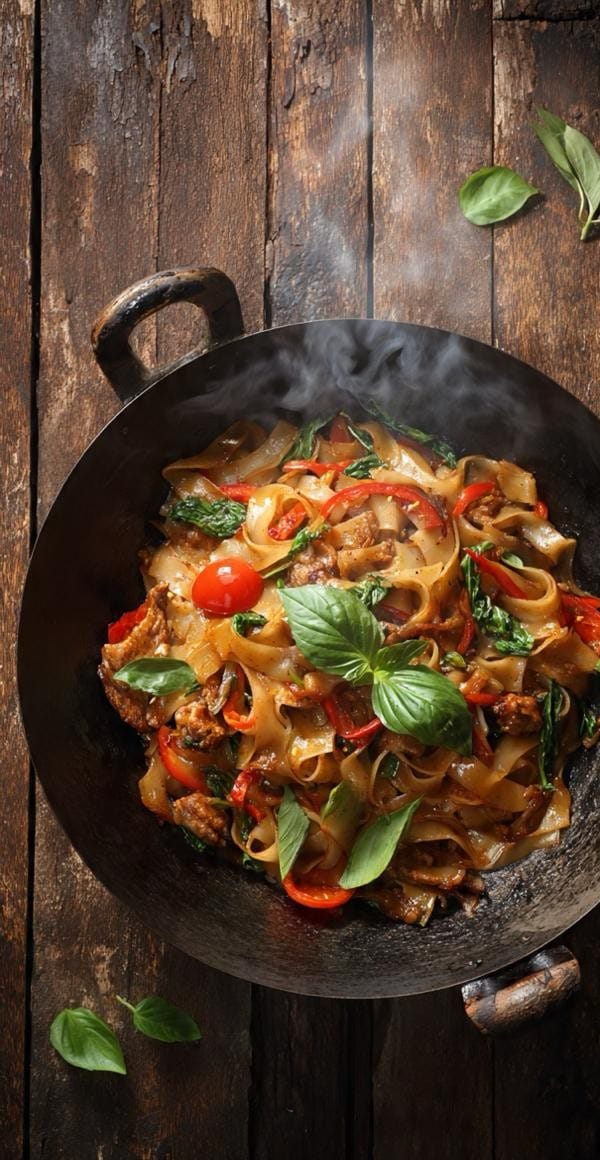
Drunken Noodles (Pad Kee Mao) — The Version Nobody Else Writes
Pad kee mao is drunk food. That's the origin story — it was made for people coming home from bars at 2am, hungry, who needed something that would soak up the alcohol and taste like heaven at 3am.
Most recipes online treat it like pad Thai's messy cousin. It's not. It has its own flavor profile: wider rice noodles, holy basil, Thai chilies, a lighter sauce, and a heat that hits different because it comes from fresh chilies not dried ones.
I wrote this version after eating pad kee mao at 3 different Thai spots in Plano and noticing something: none of them agreed on the sauce ratio. One was sweeter, one was spicier, one had more fish sauce. I took notes, went home, tested my own version until I had something that matched what I liked best — and then I upgraded it.
What You Need
- 12 oz wide fresh rice noodles (sen yai — the really wide ones, about 1-inch wide)
- ½ lb chicken thigh, sliced thin
- 5 cloves garlic, minced
- 3 bird's eye chilies, sliced (adjust — this should be spicy)
- 1 red bell pepper, sliced into strips
- 1 handful Thai basil leaves (holy basil if you can find it)
- 3 tbsp soy sauce (regular, not light)
- 1 tbsp fish sauce
- 1 tbsp oyster sauce
- 1 tsp sugar
- 2 tbsp neutral oil
- 2 green onions, sliced
The Method
- Prep before heat. Pad kee mao cooks in 90 seconds from start to finish. Mise en place or die. Sauce mixed in a small bowl — soy, fish sauce, oyster sauce, sugar. Chilies sliced, garlic minced, bell pepper ready, noodles separated. If you're still chopping when the wok is hot, you've already lost.
- Get the wok smoking. Oil over maximum heat until it shimmers. Drop in garlic — 10 seconds. Then chilies — 10 more seconds. Both should sizzle immediately. If garlic is taking more than 10 seconds to sizzle, the wok isn't hot enough.
- Protein first. Chicken in a single layer. Let it sear 30 seconds before touching it. Flip and sear the other side. 2 minutes total — just cooked through, still juicy.
- Noodles and sauce simultaneously. Toss the noodles across the entire wok surface. Pour the sauce over everything at once. Toss aggressively for 45 seconds — noodles should be coated, the sauce should be absorbed, the edges should be getting slightly charred from the hot wok.
- Bell pepper and basil. Toss in the bell pepper for 30 seconds — it should stay crunchy. Then turn off the heat and toss in the holy basil. The residual heat wilts the basil without cooking it into submission.
- Serve immediately. No resting. Pad kee mao waits for nobody. Plate, top with green onions, serve.
The Intelligence
The sauce ratio: Most recipes put fish sauce first. I put soy sauce first — 3 tbsp soy to 1 tbsp fish sauce to 1 tbsp oyster sauce. The oyster sauce adds a sweetness and a thickness that fish sauce alone can't provide. The soy provides the salt backbone. Fish sauce provides the depth. This ratio gives you the flavor profile I've tasted at the better Thai spots in Plano.
Why fresh rice noodles (sen yai), not dried: Pad kee mao traditionally uses wide fresh rice noodles — the kind that come in plastic bags at the Asian market, soft and ready to use. Dried noodles work in a pinch, but fresh noodles have a chew that dried noodles can't match, and they carry the sauce differently. If you can only find dried, soak them 10 minutes and cook 30 seconds in boiling water. They'll be fine. But fresh is the real version.
Troubleshooting — noodles are clumping: Your heat is too low or you're not tossing fast enough. Wok heat at 500°F+ means the noodles sear on contact and stay separate. Low heat means they steam and stick together. Crank it up. Move fast. If they're already clumping, add a splash of water, crank the heat, and keep tossing — the steam will release them.
Troubleshooting — no spice: You used 2 chilies and that was too little. Pad kee mao is supposed to be spicy — the chilies are the point. Start with 3, work up to 5 if you can handle it. Fresh bird's eye chilies have a different heat curve than dried ones — it hits the back of your throat, not your tongue. That's the right kind of heat.
Creative twist — the fried egg on top: Fry an egg sunny-side up in a separate pan — crispy edges, runny yolk. Slide it on top of the pad kee mao. Break the yolk into the noodles. The egg yolk creates a rich, creamy sauce that coats every noodle. This is the "drunken" part of drunken noodles — the combination of spicy noodles and rich egg at 2am after a night out. It shouldn't work. It works incredibly well.
The Science Notes
Why wide noodles: Wide fresh rice noodles (sen yai) have more surface area per noodle than thin dried ones, which means more sauce adhesion and better contact with the hot wok for charring. The chew comes from the fresh-noodle manufacturing process — they're steamed rather than dried, which preserves the gluten-like structure of the rice starch. Dried noodles lose some of this structure during the drying process and never fully recover it.
Why holy basil matters: Holy basil (different from Thai basil, different from sweet basil) has a peppery, clove-like compound called eugenol that Thai basil and sweet basil don't have in significant quantities. When added off-heat at step 5, the residual heat releases the eugenol without breaking it down. The result is a basil flavor that's more complex, spicier, and more aromatic than any other basil variety. If you can't find holy basil at H-Mart or your Asian market, use Thai basil — it's fine. But holy basil is the real version.
The drunken origin: Pad kee mao literally means "stir-fried drunkard." The original dish was served at 2am to people leaving bars. The wide noodles are filling, the chilies wake you up, the holy basil adds complexity that makes you forget you're eating drunk food. The version I tested in Plano had slightly more soy sauce than the Bangkok version — American rice noodles are different from Thai rice noodles, and the sauce needs a slight adjustment to match the starch absorption rate of the wider, starchier noodles available here.
Original recipe, tested and refined. This is the version I make when I want pad kee mao that matches what I've eaten in Plano — and it's the version I'd serve at 2am to anyone who asked.