Bún Bò Huế – Spicy Beef & Pork Noodle Soup

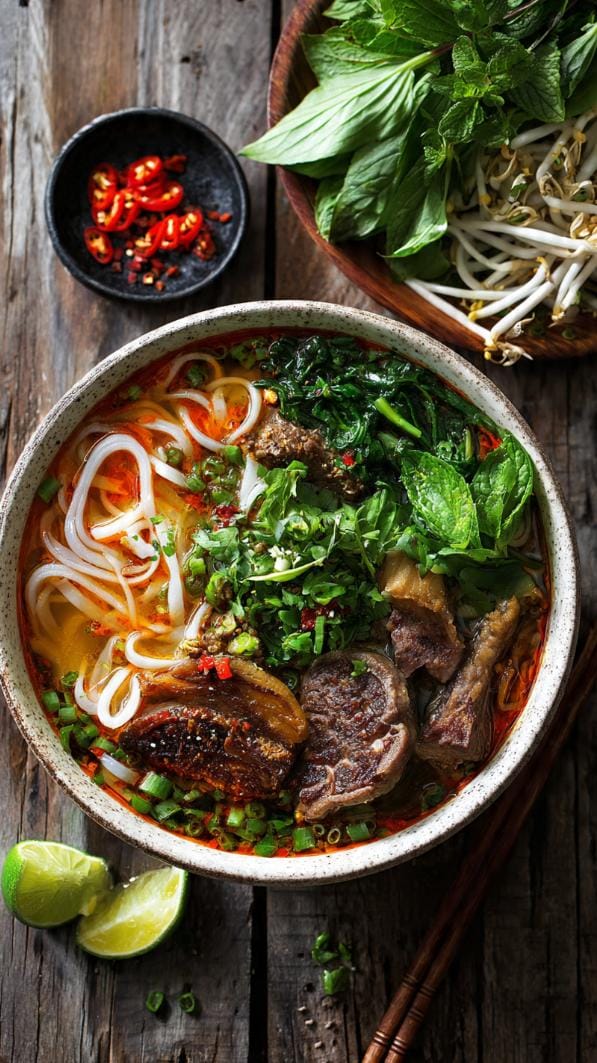
Bún Bò Huế – Spicy Beef & Pork Noodle Soup
Bún Bò Huế hasn't had its phở moment yet — at least not in the United States. It should. It's a deeply flavorful, spicy central Vietnamese soup built on beef and pork, brightened with fresh herbs, and finished with enough chili to wake you up. If phở is the gentle, approachable cousin, Bún Bò Huế is the one who shows up with something bold and unexpected every single time.
I went straight to the source on this one — my mom — to nail the subtleties that make it authentic. The version below is the real deal.
Why Isn't Bún Bò Huế More Popular?
Phở has exploded in the US — Google data shows an 830% increase in searches since 2004. Bún Bò Huế, by comparison, barely registers at about 1.2% of phở's search volume over the same period.
It's not for lack of flavor. Bún Bò Huế uses familiar ingredients — noodles, meat, herbs — but it throws in a couple of curveballs that slow mainstream adoption: shrimp paste and pork blood. Phở's concept — beef or chicken noodle soup — is instantly recognizable. Bún Bò Huế is harder to pitch in one sentence.
Don't let that stop you. It might end up being the better soup.
A Brief History
"Bún Bò Huế" translates directly to "Huế beef noodle soup." Huế became Vietnam's capital in 1802 under the Nguyen Dynasty, and the city has been associated with bold, spicy food ever since. The locals say the heat developed simply because cooks needed more flavor in an environment where other options were limited. If that's the origin story, it worked.
Huế is also responsible for some of Vietnam's most distinctive dishes: bánh nậm, bánh bột lọc, cơm hến, and of course, bún bò Huế.
The Ingredients That Take Some Getting Used To
Banana Flower
Banana flower (also called banana blossom) is a traditional addition — thinly sliced and soaked in lemon water to prevent browning and cut the bitterness. You can find it at most Asian markets, including Vietnamese, Chinese, Thai, and even some Persian markets near you.
The prep is straightforward: slice it thin, soak it in lemon water for about 30 minutes, and pick out the little fronds that look like mini bananas — those are the bitter parts. If you can't find banana flower, red cabbage works as a substitute, and most restaurants do exactly that.
The Saté — Spicy Chile Condiment
Bún Bò Huế is a spicy soup, so naturally there's a chile condiment that goes with it. The saté paste is simple in concept — rehydrate dried chiles, mince the aromatics, cook everything down until it thickens — but it takes real patience. About 30 to 40 minutes on medium heat, stirring continuously.
Make extra. It keeps in the fridge and shows up useful for future BBH gatherings or when someone needs a gift that says "I care about you and also spicy food."
Bún Bò Huế vs. Phở — What's Actually Different?
Lots of things, starting with the noodles. Phở is named after the flat rice noodles it uses. Bún Bò Huế uses round noodles — thicker, chewier, with more presence in the bowl.
The broths diverge too. Phở is typically all beef or all chicken, with meat from the same animal. Bún Bò Huế throws both beef and pork into the same pot, adds shrimp paste and pork bones, and finishes with chile paste. It's a louder, more complex broth.
Phở is still one of the best soups on the planet. Bún Bò Huế just happens to be its spicier, more complicated cousin.
Is It Actually Spicy?
Traditionally, yes. But the version here keeps the broth itself mild — zero spice in the liquid. The saté chile paste lives on the side, so everyone can dial in their own heat level without sacrificing broth flavor. That's how we handle it in my family.
Is There Pork?
Yes. The name says "beef noodle soup," but Bún Bò Huế traditionally carries as much pork as beef — sometimes more. This recipe uses pork hocks, Huế-style pork sausage, and congealed pork blood. Vegetarians, you've been warned.
How to Eat It
Chopsticks and a soup spoon. Build your bowl with noodles and broth, add as much meat as you want, then hit it with the herbs — mint, Thai basil, bean sprouts, banana flower — plus as much chile paste and lime as your taste buds can handle. The herbs cool things down and add a bright counterpoint to the rich, spicy broth.
Ingredients
Meat
- 2 lb beef shank
- 2 lb oxtail
- 2 lb pork hocks
- 1 lb Huế-style pork sausage (chả Huế — garlic and whole peppercorns)
- 1 lb pork blood, congealed (cooked or raw)
Broth Base & Seasoning
- Water — use an 8-quart pot, fill to cover the meat
- 24 oz chicken broth
- 12 stalks lemongrass — leafy tops removed, roots smashed
- 2 large yellow onions, halved (remove from broth after cooking)
- 3 tbsp salt
- 2 tbsp sugar
- 2 tbsp shrimp paste
- 3–4 tbsp fish sauce
- 2 tsp MSG — bump to 4 tsp if skipping the oxtail
Aromatics & Color
- 3 tbsp annatto seeds
- 3 tbsp neutral cooking oil
- 2 tbsp shallot, sliced
- 2 tbsp garlic, minced
Herbs & Veg
- Mint
- Thai basil
- Bean sprouts
- Bird's eye chile or jalapeño
- Lime, sliced
Banana Flower
- 1 banana flower
- 2 cups water
- 1 lemon, juiced
Noodles
- 14 oz dried thick rice noodles (medium or large)
Saté — Spicy Chile Condiment
- 20 g dried Thai chiles, crushed
- ½ cup neutral cooking oil
- 80 g shallot or white onion, minced
- 40 g garlic, minced
- 30 g lemongrass, minced
- 2 tbsp Korean chile powder (gochugaru)
- 1 tbsp fish sauce
- 1 tbsp sugar
- ⅔ tsp salt
- ½ tsp MSG
Method
The Broth
Add all the meat to a stock pot, cover with water, bring to a boil, then drain and rinse thoroughly under running water. Return the meat to a clean pot, add the chicken broth, lemongrass, and onions, then fill with water almost to the top.
Bring to a boil, then drop to medium-high to maintain a low simmer. Add the seasoning — salt, sugar, shrimp paste, fish sauce, and MSG. Let it simmer and check the meat periodically, removing each piece as it finishes. The pork hocks take about an hour; the beef can run 2 to 3 hours depending on the cut.
Once all the meat is out, let it cool and slice it against the grain. Adjust the broth seasoning, top up with water if needed, then make the aromatics and coloring and add it to the pot.
Boil the noodles per the package instructions while you're finishing the broth.
Assemble your bowls and serve with the herbs and vegetables on a side platter.
Red Coloring & Aromatics
Sauté the annatto seeds in oil on medium heat until they release their bright red color, then fish the seeds out. Add the shallots and garlic and cook until brown. Pour all of it into the broth pot — that's your color and your fragrance in one step.
Pork Blood (Huyet / Tiet)
The simplest approach is to buy it pre-cooked — just warm it through in boiling water. If you're working with raw pork blood, cut it into 1-inch cubes and boil for 30 to 45 minutes.
Banana Flower Prep
Mix about 2 cups of water with the juice of 1 lemon. Slice the banana flower thin and submerge it in the lemon water for 30 minutes. Pick out the little fronds as you go — they're bitter. The lemon water keeps the petals bright and cuts the harshness.
Saté — Spicy Chile Condiment
Weigh out the dried Thai chiles and soak them in just enough warm water to cover for 20 minutes. Drain.
Add every saté ingredient to a pan on medium heat and stir continuously — you want to brown, cook, and slightly reduce the chile paste over 30 to 40 minutes. If the pan gets too dry, add more oil, up to 50% of what you started with. Taste and adjust with sugar or salt as desired.
Let it cool, then transfer to a sealed jar in the fridge. It'll keep. A couple of tablespoons stirred into the soup pot gives the whole thing a flavor and color boost — or pass it around and let everyone spike their own bowl.