Aunty's Lao Mok Pa (Banana Leaf Fish) — What the Aunties Actually Make

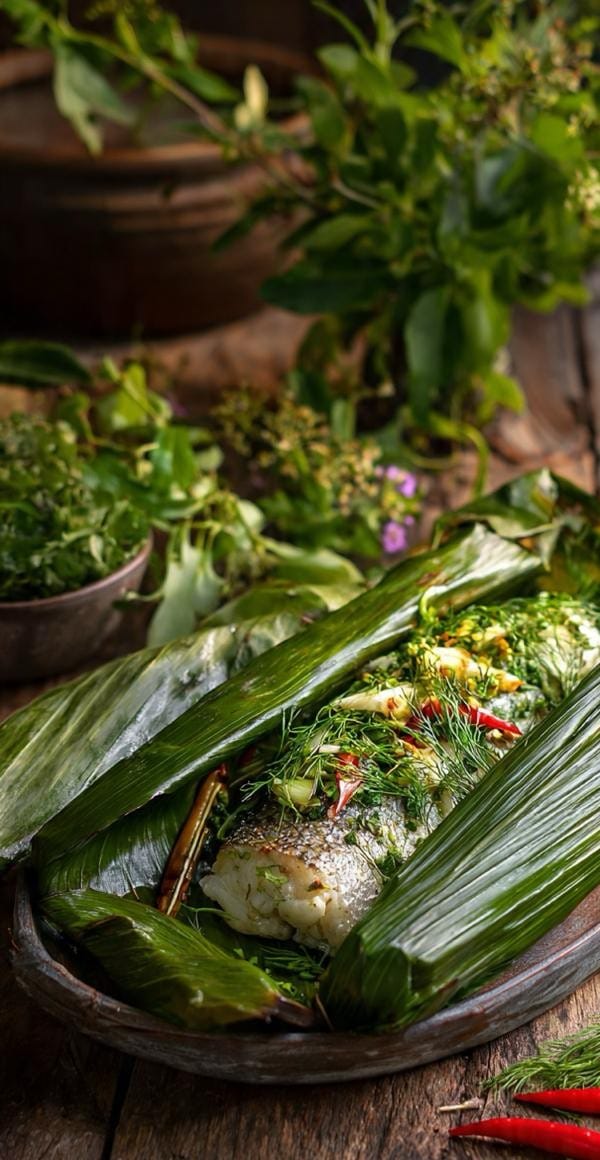
Aunty's Lao Mok Pa (Banana Leaf Fish) — What the Aunties Actually Make
Mok pa doesn't appear on most restaurant menus. You find it at home, at family gatherings, at the gatherings where the Aunties bring the food and nobody questions it because it's too good to question.
It's fish steamed in banana leaves with herbs, chilies, and a curry paste that the Aunties make from scratch because the jarred stuff doesn't taste right. The banana leaf doesn't just hold the fish — it infuses it with a grassy, smoky sweetness that no other cooking vessel provides.
I've been eating this at Lao family gatherings for 2 years. Watched the Aunties make it. Asked questions. Took notes. This is what I figured out.
What You Need
- 2 white fish fillets (snapper or sea bass, 6–8 oz each, skin-on)
- 2 tbsp red curry paste (homemade if possible — see note)
- 1 cup coconut milk
- 2 tbsp fish sauce
- 1 tsp sugar
- 3 kaffir lime leaves, thinly sliced
- ½ cup Thai basil leaves
- 2 bird's eye chilies, sliced
- 2 banana leaves (frozen section of the Asian market — thaw before using)
- String or banana leaf strips for tying
The Homemade Curry Paste (Aunty Version)
Aunties don't use Mae Ploy. They make their own. Here's the simplified version I've watched them make:
- 5 dried red chilies, soaked and seeded
- 3 cloves garlic
- 3 shallots
- 1 thumb galangal, sliced
- 1 stalk lemongrass, bottom third
- 1 tsp shrimp paste (belachan, toasted)
- ½ tsp coriander seeds, toasted
Grind everything together in a mortar until smooth. Add 2 tbsp water if needed to help it grind. This is the base. The Aunties adjust every batch — more chilies, more galangal, whatever the hand feels like. The version above is my baseline. Add more of whatever you like.
The Method
- Prepare the banana leaves. Cut each leaf into a 12×12-inch square. Pass each square quickly over a low flame or warm pan for 3–4 seconds per side — the leaf will darken slightly and become pliable. This prevents it from cracking when you fold it. Don't skip this. Rigid banana leaves crack. Pliable banana leaves hold everything together.
- Make the curry sauce. Combine curry paste, coconut milk, fish sauce, sugar, and sliced kaffir lime leaves in a bowl. Stir until smooth. It should smell sharp, creamy, and spicy all at once.
- Season the fish. Score the skin of each fillet in 3 diagonal cuts — don't cut through to the other side. This lets the curry sauce penetrate. Place each fillet skin-side down in the center of a banana leaf square.
- Add the herbs. Spoon the curry sauce over each fillet — about ¼ cup per fillet, enough to coat generously. Scatter Thai basil and sliced chilies over the top.
- Wrap it. Fold the banana leaf over the fish like an envelope — fold up from the bottom, fold in the sides, fold the top down. Tie with string or a thin strip of banana leaf. The parcel should be tight but not crushing the fish.
- Steam. Place the parcels in a steamer basket over boiling water. Steam 12–15 minutes for 1-inch thick fillets. The fish is done when it flakes easily with a fork and the internal temperature hits 145°F.
- Serve. Open the parcels at the table — the steam and the aroma hit everyone at once. Eat the fish directly from the banana leaf. The sauce at the bottom of the leaf is the best part — spoon it over rice.
The Intelligence
Why banana leaves: Banana leaves contain natural waxes and aromatic compounds that transfer to food during steaming. The wax creates a non-stick surface. The aromatic compounds (primarily eugenol and linalool) transfer into the fish and sauce, adding a subtle grassy sweetness that no other wrapping material provides. Banana leaves don't add flavor the way say, parchment paper, would — they transform the food's flavor through the compounds in their wax coating. Aluminum foil doesn't do this. Parchment doesn't do this. Only banana leaves do this.
Why homemade curry paste: Jarred red curry paste (Mae Ploy) is designed for shelf stability, not depth of flavor. The homemade version — roasted chilies, fresh galangal, lemongrass, toasted belachan — has brightness and complexity that jarred paste can't match. The Aunties make their own because they have the time and because they know the jarred stuff isn't the same. The good news: make a big batch and freeze it in ice cube trays. One cube = one serving of curry.
Troubleshooting — banana leaf cracks: You didn't warm it first. Banana leaves contain lignocellulose that becomes rigid when cold. Passing it over a low flame for 3 seconds breaks down the surface wax and softens the leaf structure. Warm leaf = pliable. Cold leaf = crack city.
What to do with leftover curry paste: Freeze it. Or use it to make a quick laap — mix a tablespoon with ground pork, lime, fish sauce, herbs. Or stir a tablespoon into coconut milk for an instant curry sauce. Homemade curry paste is useful for way more than mok pa.
The Science Notes
Why steam, not bake: Steaming at 212°F cooks fish gently and uniformly without drying out the exterior. Baking at 375°F causes the exterior proteins to coagulate and squeeze out moisture before the interior reaches temperature — the result is dry fish with a cooked exterior and a potentially undercooked center. Steam transfers heat through water vapor, which is more efficient than air at transferring thermal energy but doesn't exceed 212°F — fish never gets hotter than boiling water, which keeps it moist.
The banana leaf aromatic transfer: The wax coating on banana leaves contains eugenol (clove-like), linalool (floral), and various terpenes that are hydrophobic (oil-loving). During steaming, the heat softens the wax and these compounds dissolve into the fish skin and curry sauce simultaneously. The transfer is slow and gentle — 12–15 minutes of steaming deposits enough aromatic compounds to change the flavor profile without making it taste like banana. The result is a fish that tastes like fish elevated by something you can't quite name.
The skin scoring: Diagonal cuts in the fish skin serve two purposes: they allow the curry sauce to penetrate into the flesh beneath the skin, and they prevent the skin from curling up during steaming (the scored sections lay flat). Unscored fish skin tends to contract and bunch during cooking, leaving gaps where the curry sauce pools rather than penetrating.
Original recipe — watched the Aunties make this at family gatherings, reverse-engineered from watching, tested in my own kitchen. The banana leaf isn't decoration. It's part of the technique.