The Aunty Who Toasts Her Own Curry Paste — And Why It Changes Everything

The Aunty Who Toasts Her Own Curry Paste — And Why It Changes Everything
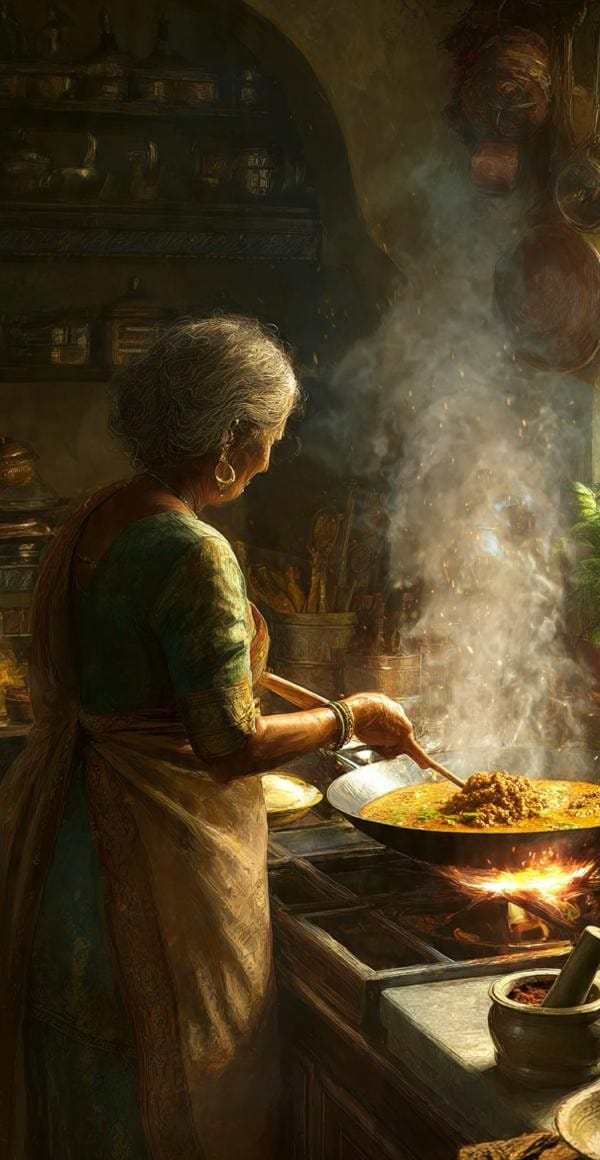
A Filipino-Chinese Aunty I know makes her own green curry paste from scratch. She doesn't use Mae Ploy. She doesn't use any jarred paste. She roasts every ingredient separately, grinds it by hand, and mixes it fresh every time she makes curry.
Her green curry doesn't taste like the green curry at Thai restaurants. It tastes brighter, cleaner, more herbal — like each ingredient is actually present instead of blended into a uniform paste. The difference is in the toasting. She toasts each ingredient at a different temperature for a different time, then grinds them together. No recipe book I've found explains this.
This is her method.
The Aunty's Curry Paste (The Upgrade)
- 10 dried green Thai chilies, stemmed
- 1 cup fresh cilantro stems and roots (roots if you can find them)
- 4 cloves garlic
- 1 thumb galangal, sliced
- 1 stalk lemongrass, bottom third
- 1 tsp coriander seeds
- ½ tsp cumin seeds
- ½ tsp white peppercorns
- 1 tsp shrimp paste (belachan, toasted)
- 1 tsp salt
- 2 tbsp water (for grinding)
The Aunty's Toasting Method
This is her upgrade — each ingredient gets its own toasting time:
- Dried chilies: Dry pan, medium heat, 2 minutes until fragrant and slightly darkened. Don't burn — burnt chilies = bitter paste. Set aside.
- Coriander seeds: Same pan, medium heat, 2 minutes until fragrant. Don't burn. Set aside.
- Cumin seeds: Same pan, 1 minute — cumin burns faster than coriander. Set aside.
- White peppercorns: Same pan, 30 seconds — they pop and smell peppery. Set aside.
- Galangal and lemongrass: Slice galangal into thin coins. Slice lemongrass thinly on the bias. Dry pan, medium heat, 3 minutes until edges start to brown and the kitchen smells like lemongrass. Set aside.
- Garlic and cilantro: Don't toast these — they burn too fast and turn bitter. Add them raw to the grind.
The Grind
Grind all the toasted ingredients in a mortar first — it takes 5 minutes of pounding. Add the raw garlic, cilantro, and belachan. Keep grinding. Add salt and water as needed to help it grind into a smooth paste. It should be bright green, almost neon. If it's dull green, you ground it too fast or the ingredients were old.
Using the Paste
The paste is now ready for green curry. Follow the green curry method from the upgraded version — fry the paste in coconut cream, add chicken, add coconut milk, simmer, finish with Thai basil. The paste is what makes the difference.
The Intelligence
Why separate toasting: Different ingredients contain different aromatic compounds that release at different temperatures and different rates. Dried chilies release their flavor compounds at 300°F over 2 minutes. Coriander seeds release theirs at 320°F over 2 minutes. Cumin seeds release theirs faster — at 350°F, they only need 60 seconds. Galangal and lemongrass need lower heat (280°F) and longer time (3 minutes) because their compounds are locked in fibrous structures that need gentler, slower extraction. If you toast everything together at the same temperature, some ingredients burn before others are done. The Aunty's separate-toasting method ensures every ingredient is toasted at its optimal temperature for its optimal time. She doesn't know the temperature. She just knows the smell and the color.
Why this beats Mae Ploy: Mae Ploy paste is designed for shelf stability — it's cooked at high temperature during manufacturing, which means some of the fresh, bright aromatic compounds are already partially degraded before you open the jar. The Aunty's fresh-roasted paste has all the aromatic compounds intact because they were roasted separately at controlled temperatures and ground fresh. The result: a paste that's brighter, more complex, and more herb-forward than anything from a jar. It's more work. The Aunty doesn't care — she's been doing it for 40 years.
What the Aunty does that recipes skip: She adds a pinch of sugar to the paste itself before frying it in coconut cream. Not in the final curry — in the paste. She says the sugar helps the paste brown slightly when fried, adding a depth that paste without sugar doesn't have. It's barely detectable in the final dish — you don't taste "sweetness" — but the browning reaction (Maillard) adds savory compounds that deepen the curry flavor. She discovered this by accident, adding too much sugar once and noticing the curry tasted better. She never corrected the mistake.
The Science Notes
The separate-toasting temperature logic: Each ingredient has a different optimal toasting temperature based on the activation energy of its aromatic compounds. Chili heat compounds (capsaicinoids) activate at 280–300°F. Coriander's citrusy linalool activates at 310–330°F. Cumin's warm cuminaldehyde activates at 340–360°F. Lemongrass's citral activates at 270–290°F. Toasting each at its optimal temperature maximizes the extraction of its specific compounds without degrading neighboring compounds. The Aunty does this by smell and color — she doesn't have a thermometer. Her nose is the instrument.
Why cilantro roots: Cilantro roots contain a higher concentration of the aromatic compound (E)-2-decenal than the leaves — approximately 3–4x higher by weight. This compound is responsible for cilantro's distinctive aroma. Roots also contain additional compounds (aldehydes, esters) not present in the leaves, creating a more complex cilantro flavor. Most recipes call for cilantro leaves only. The Aunty uses roots when she can find them (most Asian markets sell cilantro with roots attached). The result: a paste that's more cilantro-forward and more complex than paste made with leaves alone.
The sugar-in-the-paste trick: Adding ¼ tsp sugar directly to the curry paste before frying it in coconut cream causes partial caramelization of the sugar during the 3-minute fry. This creates Maillard reaction products (melanoidins) that add savory depth and a slight golden color to the paste. The sugar is mostly consumed in the browning reaction — it doesn't make the curry taste sweet, it makes it taste deeper. The Aunty's accidental discovery is a legitimate technique that no food scientist would have thought to test because it seems counterintuitive: adding sugar to make something less sweet.
This recipe comes from watching a Thai-Chinese Aunty make her own green curry paste at family gatherings in Dallas. She's been making it this way for 40 years. She's never written it down. This is the first time anyone has documented her method.